> For the complete documentation index, see [llms.txt](https://docs.kim.exchange/llms.txt). Markdown versions of documentation pages are available by appending `.md` to page URLs; this page is available as [Markdown](https://docs.kim.exchange/protocol/kim-staked-position-nfts-kpnfts.md).
# KIM Staked Position NFTs (kpNFTs)
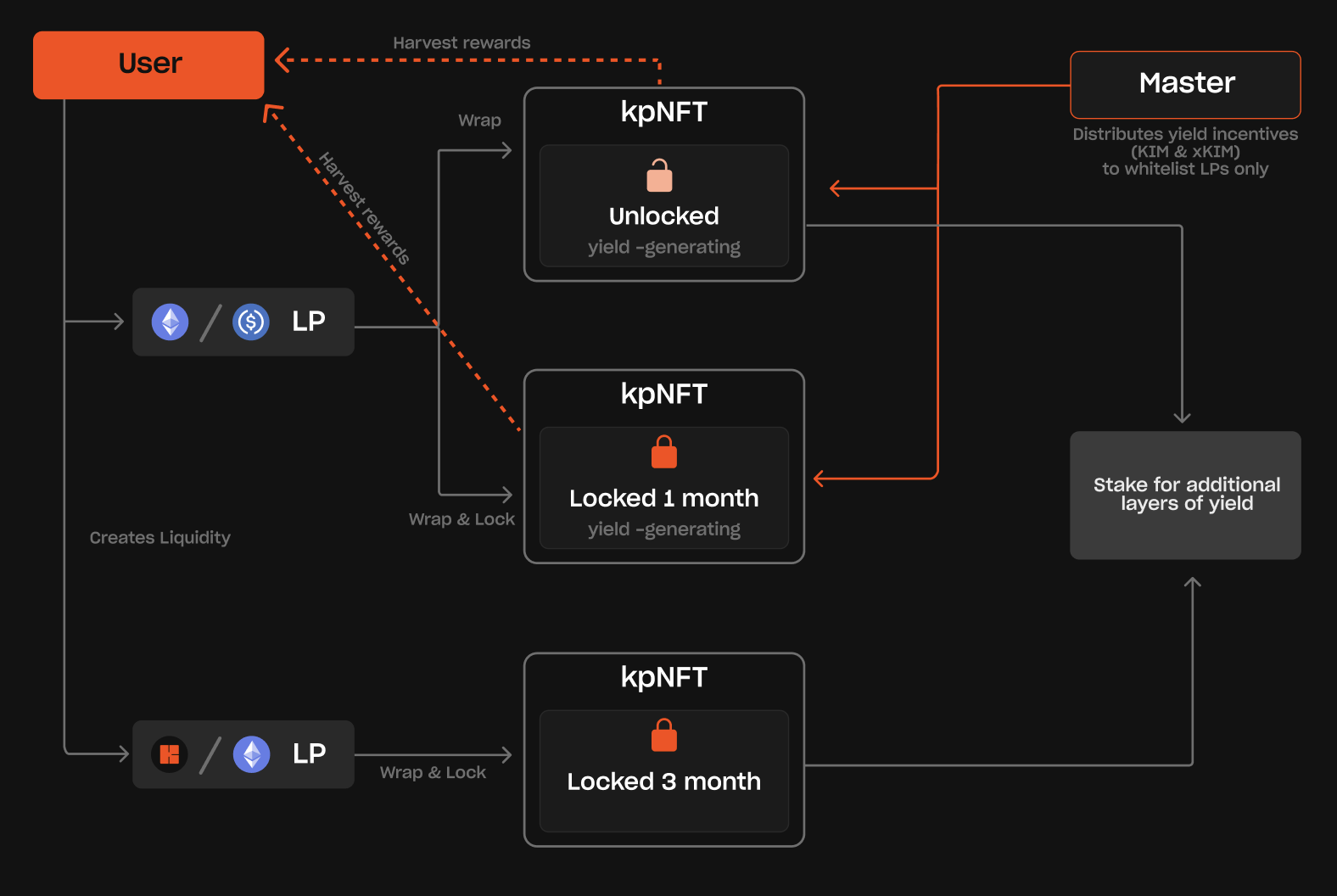
KIMs liquidity approach based on non-fungible staked positions, dubbed kpNFTs.
### How does it work?
Each KIM LP has its own KIM staking positions (or kpNFTs) that users can mint by wrapping LP tokens (i.e. depositing them on the relevant contract).
Upon creating a position, the deposit is sent to a specific corresponding NFTPool contract in exchange for a staking position NFT, which can be viewed as a kind of deposit receipt.
{% hint style="info" %}
Those receipts are the only thing allowing a user to withdraw the corresponding funds, regardless of who is using them, so the owner of a kpNFT is also the actual owner of the corresponding LPs, even if she did not deposit them originally.
{% endhint %}
But staked positions are more than simple receipts: they replace the usual farms generating yield that you will find in most of the DeFi protocols, and also play the role of an additional layer of features offering unlimited new opportunities and potential extensions.